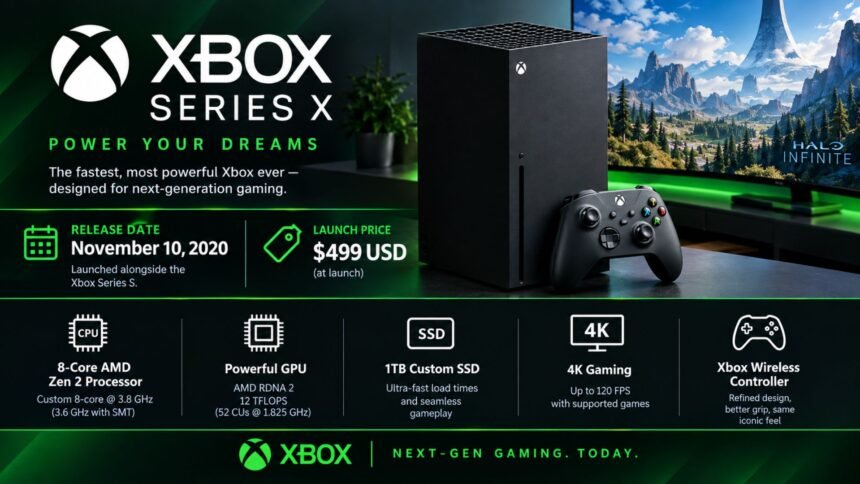
The Xbox Series X release date was November 10, 2020, marking Microsoft’s entry into the ninth generation of console gaming alongside the Xbox Series S. More than a new console, the Series X introduced faster loading, higher frame rates, improved graphics, backward compatibility, and a redesigned approach to how players access their games. Microsoft confirmed the global launch date in September 2020, with pre-orders opening on September 22.
For anyone researching when the console arrived, how much it originally cost, and what made it different from the Xbox One generation, the launch details provide a useful picture of Microsoft’s strategy.
Xbox Series X Release Date and Launch Details
The official Xbox Series X release date was November 10, 2020. Microsoft launched the console globally at participating retailers, positioning it as its most powerful Xbox at the time. The Xbox Series S launched on the same day as a smaller, less expensive alternative.
In the United States, the Xbox Series X launched with a suggested price of $499. The UK launch took place on the same date, November 10, although regional pricing and retailer availability differed. Microsoft’s pre-order announcement listed both the United States and United Kingdom among the launch markets.
| Launch Detail | Xbox Series X |
|---|---|
| Release date | November 10, 2020 |
| Original U.S. price | $499 |
| Storage | 1TB NVMe SSD |
| Optical drive | 4K UHD Blu-ray |
| Target resolution | Up to 4K |
| Maximum supported frame rate | Up to 120 FPS |
| CPU | Custom AMD Zen 2 |
| GPU | Custom AMD RDNA 2 architecture |
The original hardware specification included 1TB of NVMe storage, a custom processor based on AMD’s Zen 2 architecture, and a custom GPU delivering 12 teraflops of graphics performance. Microsoft also designed the console around HDMI 2.1 features and support for high frame rates.
Why the Xbox Series X Launch Mattered
The Xbox Series X release date represented more than a hardware refresh. Microsoft wanted the new console to make existing Xbox games and accessories more useful rather than forcing players to abandon their previous libraries.
Backward compatibility became one of the platform’s defining features. Xbox Series X supports thousands of games across four generations of Xbox, according to Microsoft’s current product information. Compatible titles can benefit from faster loading and, where supported, other improvements.
Smart Delivery was another major part of the transition. With supported games, players could purchase a title once and receive the appropriate version for the Xbox console they were using. That helped make the move from Xbox One to Series X less complicated for existing owners.
Hardware Built for Faster Gaming
The console was designed around a custom 8-core CPU and powerful GPU, with a high-speed SSD forming a central part of the experience. Microsoft’s architecture was intended to reduce loading times while giving developers more room to build detailed environments.
The system also introduced features such as hardware-accelerated DirectX ray tracing, Variable Rate Shading, Mesh Shaders, and Sampler Feedback. These technologies were intended to improve visual quality and allow developers to use hardware resources more efficiently.
💡 Pro Tip:
If you are comparing an Xbox Series X with an older Xbox One console, pay attention to your television or monitor as well as the console. A display with 4K resolution, HDMI 2.1 support, and a high refresh rate can make a bigger difference to the visible benefits of the newer hardware.
Games Available Around Launch
The Xbox Series X release date arrived with a mixture of new-generation titles, upgraded games, and backward-compatible releases rather than a single blockbuster exclusive defining the entire launch.
Microsoft announced 30 games optimized for Xbox Series X and Series S at launch. The list included titles such as Assassin’s Creed Valhalla, Watch Dogs: Legion, Yakuza: Like a Dragon, Gears Tactics, and Tetris Effect: Connected.
The strategy was significant because many players did not have to buy an entirely new collection of games to benefit from the console. Supported Xbox One games could receive improvements, while thousands of backward-compatible titles remained playable.
Microsoft also highlighted upcoming releases during the launch period, including Call of Duty: Black Ops Cold War, Destiny 2: Beyond Light, and The Medium.
Xbox Series X vs. Xbox Series S
The Xbox Series X and Series S launched together, but they targeted different types of players.
The Series X was designed as the premium model, offering a disc drive, more powerful graphics hardware, and 1TB of storage in its original configuration. The Series S focused on a smaller design and digital gaming at a lower launch price.
That distinction remains useful when considering which console suits a particular setup. Players with a large physical game collection or a 4K television may prefer the Series X, while someone who primarily purchases digital games may find the Series S sufficient.
Is Xbox Series X Still Relevant?
The Xbox Series X release date may be several years in the past, but the console remains relevant because Microsoft’s Xbox ecosystem was designed around compatibility and cross-generation access.
The platform supports games from previous Xbox generations, and Xbox Series X|S-optimized titles can take advantage of the newer hardware. Features such as Quick Resume, faster storage, high frame rates, and improved graphics can also make supported games feel substantially different from their Xbox One versions.
For existing Xbox owners, the decision is therefore less about simply buying a newer machine and more about whether the improvements match their gaming habits. Someone who plays demanding modern games on a 4K display may notice the benefits more than a casual player using an older 1080p television.
What Was the Original Launch Price?
At launch, the Xbox Series X carried a U.S. suggested price of $499, while the Xbox Series S launched at $299. Microsoft also promoted Xbox All Access, allowing eligible customers to obtain a console alongside Game Pass Ultimate through monthly payments.
Prices today can vary depending on the model, retailer, region, bundles, and availability. Consequently, the original launch price should not be confused with the current retail price.
📌 Key Takeaway:
The Xbox Series X launched on November 10, 2020, with a $499 U.S. launch price and hardware designed around fast SSD storage, high-performance graphics, backward compatibility, and up to 120 FPS gaming. Its strongest long-term advantage is the broader Xbox ecosystem rather than the launch date alone.
Frequently Asked Questions
When was the Xbox Series X released?
The Xbox Series X launched on November 10, 2020. Microsoft released it alongside the Xbox Series S as part of its ninth-generation Xbox lineup. The launch took place globally at participating retailers, with pre-orders beginning on September 22 in selected markets.
How much did the Xbox Series X cost at launch?
The original U.S. suggested retail price was $499. The Xbox Series S was introduced at $299, creating a lower-cost option for players who wanted the new generation without the higher hardware specification of the Series X.
Can Xbox Series X play older Xbox games?
Yes. Microsoft says the console is compatible with thousands of games spanning four generations of Xbox. Compatible games can also benefit from features such as faster loading, while supported titles may receive additional enhancements through Xbox technologies.
Does Xbox Series X support 4K gaming?
Xbox Series X was designed for native 4K gaming and supports resolutions and frame rates appropriate to the game and display. It can also support up to 120 FPS in compatible titles and setups. The actual resolution and frame rate depend on the individual game and television or monitor.
Is Xbox Series X the same as Xbox Series S?
No. Both consoles belong to the same generation, but the Series X is the more powerful model and includes a 4K UHD Blu-ray drive in its original design. The Series S is smaller, digital-only, and was launched at a lower price.
The Xbox Series X release date established November 10, 2020, as an important milestone for Microsoft’s console business. Its combination of powerful hardware, SSD storage, backward compatibility, and support for high-resolution gaming helped define the Xbox experience for the generation. For buyers evaluating the console today, its value is best judged by the games they play, the display they use, and how much they value physical media and high-end performance.
Conculsion
The Xbox Series X release date on November 10, 2020, marked the beginning of a new generation of Xbox gaming. With powerful hardware, fast SSD storage, 4K support, high frame rates, and extensive backward compatibility, the console offered a significant step forward from the Xbox One generation. Its long-term appeal comes from Microsoft’s broader gaming ecosystem, making the Xbox Series X a strong choice for players who value performance, physical games, and access to a large library of titles.