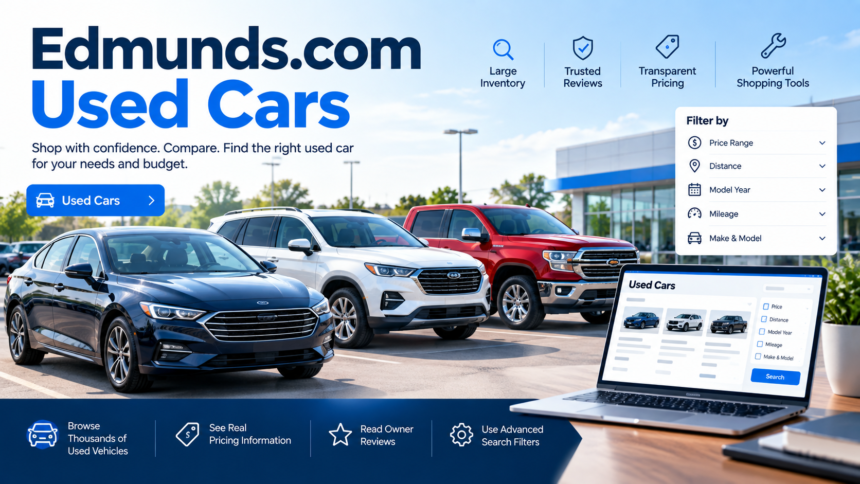
Shopping for a pre-owned vehicle involves more than finding a model that looks good and fits your budget. Edmunds.com used cars gives shoppers a starting point for browsing available vehicles, comparing prices, researching models, and checking valuation information. Edmunds currently provides a used-car marketplace with more than one million listings, along with tools for vehicle values, financing, affordability, and certified pre-owned inventory.
The real advantage comes from using those resources as part of a broader buying process. A listing price alone does not tell you whether a vehicle is right for your needs or whether its condition justifies the asking price. Research, vehicle history, an inspection, and careful review of the purchase terms still matter.
What Can You Find on Edmunds.com Used Cars?
The Edmunds used-car marketplace allows shoppers to search vehicles based on factors such as make, model, year, price, and location. Listings can help you narrow a large market into vehicles that match your requirements.
The platform also connects car shoppers with other research tools. Edmunds offers used-car valuation information, vehicle reviews, specifications, affordability tools, financing resources, and certified pre-owned information.
That combination is useful because shopping and research can happen together. Instead of judging a vehicle solely from photographs or an advertised price, you can investigate the model and consider how the asking price compares with available valuation information.
Research the Vehicle Before Contacting the Seller
Start by identifying several vehicles that meet your practical requirements. Think about passenger space, fuel economy, cargo capacity, drivetrain, safety equipment, mileage, and expected ownership costs.
Edmunds recommends creating a target list rather than immediately committing to one vehicle. Comparing several models can reveal alternatives that offer similar functionality at different prices.
You should also consider costs beyond the purchase price. Insurance, fuel, maintenance, registration, financing, and possible repairs can significantly affect the overall cost of ownership.
| Research area | What to check | Why it matters |
|---|---|---|
| Asking price | Similar listings and valuation information | Helps establish a reasonable price range |
| Vehicle history | Ownership, accidents, title and repair information | Reveals potentially important history |
| Mileage | Mileage relative to age and maintenance records | Adds context to the vehicle’s condition |
| Condition | Tires, brakes, body, interior and mechanical components | Helps identify upcoming expenses |
| Warranty | Factory, dealer or certified coverage | Determines what repairs may be covered |
| Financing | Interest rate, term and total repayment | Shows the true cost of borrowing |
How to Evaluate a Used-Car Listing
A used-car listing is a starting point, not proof that the vehicle is a good purchase.
Look closely at the advertised mileage, trim level, equipment, drivetrain, ownership history, and seller information. If a listing claims features that are not standard for that particular trim, verify them before making assumptions about the vehicle’s value.
Price deserves similar attention. Edmunds’ valuation tools are designed to provide a reference point for used vehicles, but individual cars can differ because of mileage, condition, options, history, and location. Edmunds notes that valuation information should be treated as a baseline rather than an exact price for every individual vehicle.
That distinction matters. Two cars with the same year, make, and model can reasonably have different prices if one has significantly lower mileage, better equipment, stronger maintenance records, or a cleaner history.
💡 Pro Tip:
Save several comparable listings before contacting a seller. Comparing similar vehicles with similar mileage and equipment gives you a stronger reference point than looking at one advertised price in isolation.
Check the Vehicle History and Condition
A vehicle history report should be part of your due diligence. The Federal Trade Commission recommends obtaining vehicle history information before buying a used car. Depending on the source and vehicle, reports can reveal ownership history, accident information, repair records, title problems, or salvage history.
Do not stop with the report. The FTC also recommends having a used vehicle inspected by an independent mechanic before purchase.
During a test drive, pay attention to braking, steering, transmission behavior, unusual noises, warning lights, suspension behavior, and how the vehicle performs in different driving conditions. A professional inspection can identify mechanical problems that are difficult to detect during a short drive.
Edmunds.com Used Cars and Price Research
One of the more useful parts of the Edmunds ecosystem is the ability to research what a vehicle may be worth before discussing the final price.
A valuation estimate should not be treated as an automatic offer or guaranteed market price. The actual transaction can depend on location, vehicle condition, equipment, supply, demand, seller type, and other factors.
Use valuation information as one piece of evidence. Then compare it with current listings for similar vehicles. If one vehicle is substantially more expensive than comparable examples, look for a reason. It may have unusually low mileage, additional equipment, certification, warranty coverage, or a documented maintenance history.
If there is no clear explanation, the comparison gives you a useful question to raise with the seller.
Dealer Purchases and the FTC Buyers Guide
If you purchase from a dealer, pay attention to the Buyers Guide. The FTC Used Car Rule requires dealers covered by the rule to display a Buyers Guide on used vehicles they offer for sale. The guide indicates whether the vehicle is being sold with a warranty or “as is” and provides other important information.
Do not rely on verbal promises. The FTC advises buyers to get important promises in writing and to understand the warranty terms before completing the transaction.
Also ask about the dealer’s return policy before signing. Federal law does not generally provide a three-day cancellation period for a vehicle purchase, although individual states or dealers may provide different rights or policies.
Common Mistakes to Avoid
Several mistakes can turn an apparently attractive used-car deal into an expensive purchase.
- Focusing only on the monthly payment instead of the total purchase cost
- Ignoring insurance, fuel, maintenance, and registration expenses
- Skipping an independent inspection
- Assuming a clean-looking vehicle has a clean history
- Comparing prices without accounting for mileage and equipment
- Accepting verbal promises that are not included in the paperwork
- Rushing because a seller claims another buyer is interested
A better approach is to slow the process down. Research several vehicles, verify important information, inspect the car, and review every document before committing.
📌 Key Takeaway:
Edmunds.com used cars can make the research stage easier by combining vehicle listings with pricing, reviews, specifications, and shopping tools. The strongest buying process, however, combines online research with independent verification of the vehicle’s history, condition, warranty, and final purchase terms.
Frequently Asked Questions
Is Edmunds good for finding used cars?
Edmunds provides a large used-car marketplace alongside vehicle research and valuation tools. It can help shoppers narrow their search and compare available vehicles. Buyers should still independently verify the vehicle’s condition, history, documentation, and final transaction terms before purchasing.
Can I check what a used car is worth on Edmunds?
Yes. Edmunds provides used-vehicle valuation information that can serve as a reference when evaluating an asking price. The estimated value is not a guarantee of what every individual vehicle should sell for because mileage, condition, options, history, location, and other factors can affect pricing.
Should I get a used car inspected before buying?
Yes. An independent inspection can uncover mechanical or safety issues that may not be obvious from photographs, a listing, or a short test drive. The FTC specifically recommends having a used vehicle inspected by an independent mechanic before purchase.
Does a used-car dealer have to provide a Buyers Guide?
Dealers covered by the FTC Used Car Rule generally must display a Buyers Guide on used vehicles offered for sale. The guide provides information about warranty coverage and whether the vehicle is being sold “as is.” State requirements can differ, including in Maine and Wisconsin.
What should I compare when shopping for a used car?
Compare more than the advertised price. Look at mileage, condition, equipment, vehicle history, maintenance records, warranty coverage, financing costs, and similar listings. Comparing several vehicles with similar specifications can help you understand whether an asking price is reasonable.
Conclusion
Edmunds.com used cars can be a practical starting point for shoppers who want to research vehicles before visiting a dealership or contacting a seller. Listings are most useful when combined with valuation research, model information, vehicle-history checks, an independent inspection, and careful review of the paperwork.
The goal is not simply to find a low advertised price. It is to understand what you are buying, what it is likely to cost to own, and whether the specific vehicle’s condition and documentation support the deal being offered.