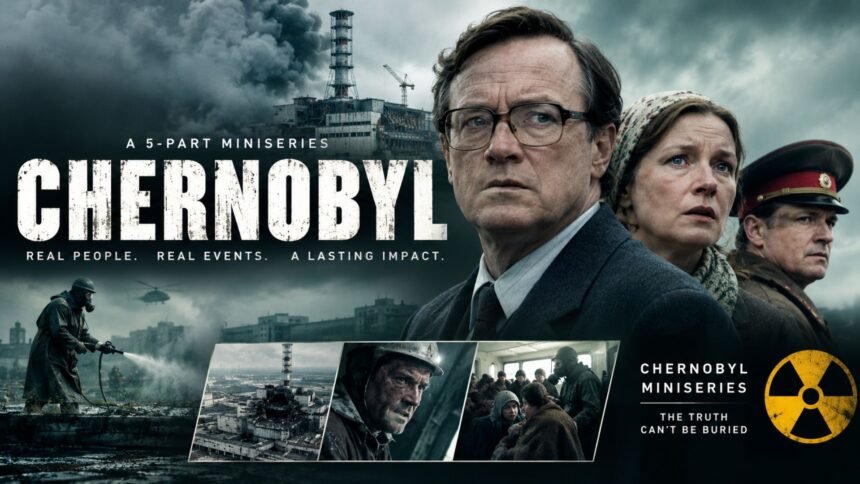
Chernobyl (miniseries) is a five-part HBO historical drama about the 1986 nuclear disaster at the Chernobyl Nuclear Power Plant in Soviet Ukraine. Starring Jared Harris, Stellan Skarsgård, and Emily Watson, the series focuses not only on the reactor explosion but also on the people who tried to understand, contain, and respond to the catastrophe. HBO describes it as a miniseries telling the story of the 1986 nuclear accident.
Created by Craig Mazin and directed by Johan Renck, the production combines real historical events with dramatized characters and scenes. That distinction matters: the series is based on a genuine disaster, but it is still a television drama rather than a documentary.
What Is Chernobyl (Miniseries) About?
The story begins during the early hours of April 26, 1986, when Reactor No. 4 at the Chernobyl Nuclear Power Plant exploded during a safety test. The disaster released radioactive material into the surrounding environment and created an emergency that extended far beyond the plant itself.
The drama follows several perspectives as authorities struggle to determine what happened and how dangerous the situation has become. Scientists, firefighters, plant workers, government officials, soldiers, miners, and ordinary residents all become part of the unfolding crisis.
Rather than treating the explosion as a single event, the series examines the chain of decisions, technical problems, institutional pressures, and human actions surrounding it. That approach gives the story its central tension: understanding the accident is only the beginning of dealing with its consequences.
The Main Cast and Characters
The performances are central to the show’s storytelling.
Jared Harris plays Valery Legasov, a Soviet nuclear physicist who becomes deeply involved in the response to the disaster. Stellan Skarsgård portrays Boris Shcherbina, a senior Soviet official assigned to oversee the government response alongside Legasov.
Emily Watson plays Ulana Khomyuk, a nuclear physicist who investigates the disaster and challenges official assumptions. Unlike Legasov and Shcherbina, Khomyuk is a fictional composite character created to represent scientists who contributed to understanding the accident.
Other important performers include Jessie Buckley as Lyudmilla Ignatenko and Paul Ritter as Anatoly Dyatlov. Their characters help the series move from government offices and control rooms to the personal consequences experienced by workers and families.
| Element | Detail |
|---|---|
| Series | Chernobyl |
| Format | Five-part miniseries |
| Network | HBO |
| Release year | 2019 |
| Creator | Craig Mazin |
| Director | Johan Renck |
| Key cast | Jared Harris, Stellan Skarsgård, Emily Watson |
| Subject | The 1986 Chernobyl nuclear disaster |
How Historically Accurate Is the Series?
One of the most common questions about Chernobyl (miniseries) is how closely it follows real history. The answer requires some distinction.
The central disaster, major scientific problems, Soviet response, evacuation, emergency operations, and enormous human risks are rooted in historical events. However, several characters and scenes were adapted for dramatic storytelling.
Ulana Khomyuk, for example, was not a single historical individual. She was created as a composite representation of numerous scientists involved in investigating the accident. The series also condenses timelines and combines events that occurred over longer periods.
That does not mean the drama should be treated as a documentary. Its purpose is to communicate the scale and human dimensions of a complicated historical event through a focused narrative.
💡 Pro Tip:
If you are watching the series to learn about the real disaster, use it as a starting point rather than your only source. Compare major scenes and characters with historical records afterward, especially when a dramatic moment seems unusually precise or personal.
Why the Chernobyl Disaster Was So Difficult to Control
The crisis presented an extraordinary combination of technical, environmental, and organizational challenges.
Immediately after the explosion, many people did not fully understand the extent of the reactor damage. Radiation could not be seen, smelled, or detected through ordinary human senses, making the danger difficult for unprotected workers and residents to comprehend.
Firefighters arrived believing they were dealing with a conventional industrial fire. Plant personnel and emergency workers then faced increasingly dangerous conditions as officials attempted to control the damaged reactor and limit further contamination.
The response required people to work under extreme circumstances. Firefighters, plant employees, military personnel, engineers, miners, medical workers, and others became involved in the enormous cleanup and containment effort.
The series emphasizes this human dimension repeatedly. Some people understood the risks only after entering dangerous areas, while others were operating with incomplete information.
The Meaning Behind the Series
Beyond the disaster itself, Chernobyl (miniseries) is concerned with information, responsibility, and institutional decision-making.
Its central conflict is not simply between humans and radiation. Much of the drama comes from the difficulty of acknowledging an inconvenient truth when the consequences of admitting it are enormous.
Scientific evidence, government authority, professional responsibility, and personal courage repeatedly collide. Characters must decide whether to accept official explanations or investigate evidence that challenges them.
This makes the series more than a disaster drama. It is also a study of how organizations respond when reality conflicts with established assumptions.
Episodes and Story Progression
The five episodes gradually expand the scope of the disaster.
The opening episode establishes the reactor accident and its immediate aftermath. Later episodes examine the Soviet response, the investigation into the causes, the evacuation and cleanup efforts, and the eventual attempt to establish responsibility for what happened.
Instead of moving rapidly from one major spectacle to another, the story spends considerable time showing the practical consequences of the disaster. This includes emergency work, scientific investigation, political pressure, and the experiences of people exposed to the crisis.
That slower progression is one reason the series feels different from a conventional disaster thriller.
📌 Key Takeaway:
Chernobyl (miniseries) works best when viewed as a historical drama grounded in real events but shaped by dramatic storytelling. Its strongest subject is not simply the explosion; it is the human and institutional response that followed.
Why the Miniseries Remains Relevant
The continuing interest in Chernobyl comes partly from the unusual combination of history, science, politics, and personal drama.
The production makes complicated nuclear concepts understandable without turning every scene into a technical lecture. At the same time, it shows that a technological disaster can become a social and political crisis when information is incomplete or delayed.
Its production also demonstrates the value of focusing on individuals within enormous historical events. Viewers encounter the disaster through scientists, workers, emergency personnel, officials, and families rather than through statistics alone.
HBO continues to list Chernobyl among its drama programming, describing the series as the story of the 1986 nuclear accident.
Frequently Asked Questions
Is Chernobyl (miniseries) based on a true story?
Yes. The series is based on the real 1986 Chernobyl nuclear disaster. However, it is a dramatization rather than a documentary. Some characters are fictional composites, while certain events and timelines were condensed or rearranged to create a coherent television narrative.
How many episodes does Chernobyl have?
Chernobyl is a five-part miniseries. Its story covers the reactor accident, the immediate emergency, the investigation, the cleanup response, and the effort to establish what caused the disaster and who was responsible.
Is Ulana Khomyuk a real person?
No. Ulana Khomyuk, played by Emily Watson, is a fictional composite character. She represents the work of multiple Soviet scientists involved in investigating the disaster rather than portraying one specific historical individual.
Who stars in the series?
The principal cast includes Jared Harris as Valery Legasov, Stellan Skarsgård as Boris Shcherbina, and Emily Watson as Ulana Khomyuk. Jessie Buckley, Paul Ritter, and other performers also have important roles in the five-part drama.
Is the series a documentary?
No. It is a scripted historical drama. The central disaster and many major circumstances are based on historical records, but individual scenes, dialogue, character combinations, and chronology can be dramatized for storytelling purposes.
Conclusion
Chernobyl (miniseries) remains a powerful historical drama because it approaches the 1986 disaster through the people who experienced its consequences rather than treating the event as a simple technological failure. Its fictionalized elements should be distinguished from documented history, but the series provides a compelling introduction to the scale, complexity, and human cost of the Chernobyl accident.
For viewers interested in historical dramas, nuclear history, Soviet history, or real-world disasters, the five-part series offers a focused narrative that can serve as a starting point for deeper research.